
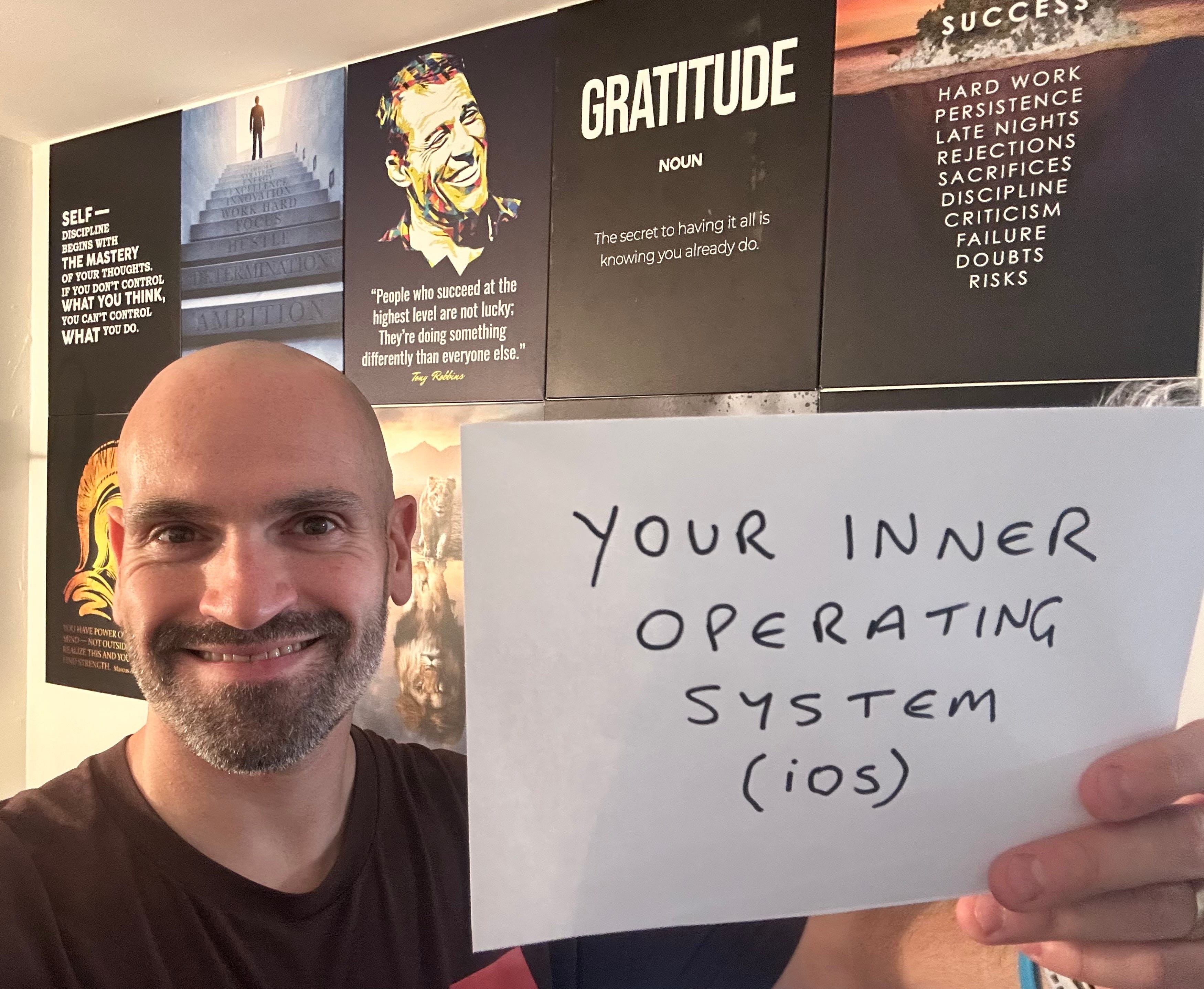
Your Inner Operating System (iOS)
Reprogram Your Mind, Transform Your Reality

You know that moment when you react the same way to the same trigger and think “why do I keep doing this?”
Every morning, you boot up the same mental software. The same automatic responses. The same limitations. The same reality.
But here’s what that outdated programming is actually costing you: You’re getting the same average results year after year. Having the same relationship conflicts. Hitting the same problems. Making the same excuses for why “people like you” don’t achieve big goals. You’re watching others succeed while you stay stuck in patterns you inherited decades ago.
When did you last check what programs are actually running in your mind?
I used to think I was just “being realistic” about my limitations. Turns out, I was running decade old software in a modern world.
Most people inherited their mental operating system from childhood and wonder why their adult life feels stuck on repeat. They blame circumstances, other people, “bad luck” — never realising their operating system is desperate for an upgrade.
Your Inner Operating System (IOS) is the collection of mental programs that determine what you notice, how you respond, and what becomes possible.
Dr. Joe Dispenza’s research proves that we can literally rewire our brains by changing our thoughts and behaviours. But most people don’t know how to systematically debug their mental software.
In the next 10-15 minutes, you’ll discover the exact 4-step protocol I used to identify and upgrade the three core programs that were keeping me stuck — and how to reprogram your automatic responses so your internal software finally matches your external goals.
The brutal truth: You don’t have a reality problem. You have a programming problem.
What is your Inner Operating System (iOS)?
Every device runs on an operating system that determines its capabilities. Your mind works the same way.
Your internal IOS consists of three core programs:
Perception Software: What you notice and how you interpret it
Response Software: Your automatic reactions and behaviours
Possibility Software: What your mind believes is achievable
Most people are running IOS 1.0 — the version installed during childhood by parents, teachers, and early experiences. They then wonder why their life feels stuck on repeat.
Your reality isn’t created by what happens around you. It’s created by the operating system processing what happens around you.
The wake-up call
Rewinding to 2020, I realised I was running ancient software.
My Perception Software was programmed for victimhood and blame. I noticed who was at fault before looking for solutions. When something went wrong, my mind immediately scanned for someone else to blame — people around me, my clients, other people’s “unfair advantages.” I was literally programming myself to see problems as things happening TO me rather than opportunities to grow FROM. I judged everyone’s choices while complaining about my own circumstances. I was filtering out my own power and responsibility.
My Response Software was completely unconscious. I reacted to everything instead of consciously responding to anything. Someone would challenge my idea and I’d immediately get defensive. An unexpected email would trigger anger before I’d even read it properly. A setback would send me spiralling into self-doubt for days, weeks or even months. I wasn’t choosing my responses — I was at the mercy of whatever emotional program got triggered first. Every reaction was automatic, unconscious, and usually destructive.
My Possibility Software had completely shut down. I didn’t believe anything was possible for someone like me. My life was just the way it was, and change couldn’t happen. I’d look at successful people and think “that’s for them, not me.” When someone suggested a bigger goal, I’d immediately explain why it was impossible. “I’m not the type of person who…” “People like me don’t…” “That works for others but…” My own mind had become a prison of limitations.
I thought this WAS me. I called it “being realistic” or “being careful.” I didn’t realise I was just running outdated programming.
I wasn’t choosing my responses. I was defaulting to them.
The upgrade
I started treating my mind like the powerful computer it is. Not something to ignore or fight, but something to consciously upgrade.
I identified my default programs. I studied what successful people were running instead. I started debugging my automatic responses and installing new ones.
Some old programs fought back. Some crashed before they upgraded properly. Some required multiple reinstalls.
My internal software started matching my external goals. The person I was becoming in my mind started showing up in my reality.
Your operating system doesn’t just influence your decisions — it determines what decisions you can even consider.
My current Inner Operating System
These aren’t aspirational programs — they’re the ones processing my reality every single day:
Perception Software v3.0: I notice opportunities and solutions before problems and blame. When something goes wrong, my mind immediately asks “what can I learn from this?” and “how can I use this to improve?” When I see someone succeeding, I study their system instead of making excuses or judgments. I’ve programmed myself to spot personal responsibility and growth opportunities in situations where I used to see victims and villains.
Response Software v2.8: I consciously respond instead of unconsciously reacting. When faced with a trigger, I pause and choose my response rather than letting my emotions choose for me. Instead of getting defensive when challenged, I get curious. Instead of letting setbacks spiral me into self-doubt, I use them as data for course correction. I’ve automated conscious choice as my first response, not emotional reactivity.
Possibility Software v4.1: I assume change is not only possible but inevitable when I apply the right systems. When I set a goal, my mind immediately starts designing the path instead of listing the reasons why i can’t achieve it. I’ve expanded my identity to include outcomes that used to seem impossible for “someone like me.” I now believe that anyone can change anything if they’re willing to upgrade their inner operating system.
The programming problem
Most people treat their mindset like weather — completely out of their control.
Let’s challenge this thought process.
Your Internal Operating System is your cathedral. You built it, and you can rebuild it.
Ask yourself:
When something goes wrong, do you automatically look for someone to blame or something to learn?
Are you unconsciously reacting to life or consciously responding to it?
Do you believe change is possible for you, or do you think your life is just “the way it is”?
Which of your limitations are real and which are software bugs?
The people living extraordinary lives aren’t running better hardware. They’re running better software.
The cost of outdated programming
Every day you run victim-mode software is a day you’re giving away your power to create change.
Every unconscious reaction is your old programming hijacking your future.
Every “that’s just how I am” is a program running that you didn’t consciously choose.
Your current operating system either expands your reality or shrinks it. It either processes opportunities or filters them out.
There’s no neutral. There’s no “i’m just being me.” There’s intentional programming or accidental programming.
Debug your mental software like your life depends on it.
Because it does.
The iOS Upgrade Protocol
You’ve identified the problem. You’re running outdated mental software that’s filtering out the reality you want to create. Here’s the 4-step system to completely reprogram your automatic responses:
Step 1: Debug Your Current System
The Pattern Audit: For one week, track your automatic responses in these situations:
When something goes wrong (do you blame or look for lessons?)
When someone challenges you (do you react defensively or respond curiously?)
When you see someone successful (do you judge or study?)
When someone suggests a big goal (do you assume impossibility or explore possibility?)
At the end of the week, write down:
What you noticed first
Your immediate emotional response
Your automatic thoughts
What you did next
The Reality Filter Test:
List 5 things you believe are “impossible” for “someone like you”
For each one, ask: “Is this actually impossible, or am I running old ‘that’s just how I am’ programming?”
Step 2: Design Your Target Operating System
Define your three software upgrades:
Perception: What do you want to notice first when challenges arise? (Responsibility and opportunity vs. blame and victimhood)
Response: How do you want to respond instead of react? (Conscious choice vs. unconscious emotional triggers)
Possibility: What do you want to believe about change and your potential? (Growth and possibility vs. “that’s just how I am”)
Example Target Programming:
Perception: “I notice opportunities to take responsibility and grow”
Response: “I pause and consciously choose my response to any trigger”
Possibility: “I believe change is always possible when I upgrade my systems”
Write specific programs, not vague aspirations.
Step 3: Install New Programming
Morning Installation (5 minutes of intentional thinking):
Visualise yourself running the new program in challenging situations
Mentally rehearse choosing responsibility over blame, response over reaction, possibility over limitation
Feel the emotions of operating with upgraded software
Real-Time Debugging:
Catch yourself running old victim/blame/reaction programs
Pause and consciously choose the new response
Celebrate each successful program execution
Evening Review: (5 minutes of intentional reviewing)
Note when you chose responsibility vs. blame, response vs. reaction, possibility vs. limitation
Identify what triggered reversions to old software, without judgment.
Step 4: Test and Optimise
Weekly System Checks:
Ask Yourself (and write these down. Pen and paper)…
Are you taking more responsibility for your circumstances?
Are you responding consciously instead of reacting emotionally?
Are you believing more is possible for your future?
Rinse and repeat the above protocol for as long as required.
The Reality Shift
When your internal software upgrades from victim to creator, from reactor to responder, from limited to limitless, your external reality has no choice but to follow.
Your Inner Operating System is the difference between living by default and living by design.
The beauty of this system? You can constantly upgrade your software. Your perceptions can change. Your reality can shift. Your possibilities can expand. Version 2.0 doesn’t have to be your final release.
Start the upgrade today. Your future reality is waiting for better programming.
To your growth,
-Chris
The metaphor of an inner operating system is sharp, but maybe also misleading. A machine runs clean code or crashes. Humans don’t work like that. We live in contradiction, and often the “bugs” in our system are not errors to be deleted but signals pointing toward something unresolved, something essentially human.
Philosophy has always wrestled with this: how much of life is about control, and how much is about bearing what cannot be controlled? If I try to treat every reaction, every limitation, as software to be debugged, I risk reducing existence to maintenance. And yet the raw edges, the paradoxes, even the spirals, they’re part of what makes a life real, not just efficient.
So maybe the task isn’t to perfect the code, but to learn when to upgrade and when to sit with the mess. Because the glitches we want to erase are often the same cracks through which truth leaks in.